The Julio-Claudian Family Tree, Explained
Five emperors, 94 years, and not one succeeded by his own son. How Augustus, Tiberius, Caligula, Claudius and Nero were related, by blood, marriage and adoption.
By Thomas van der Bruggen, Cartouche Maps · Published

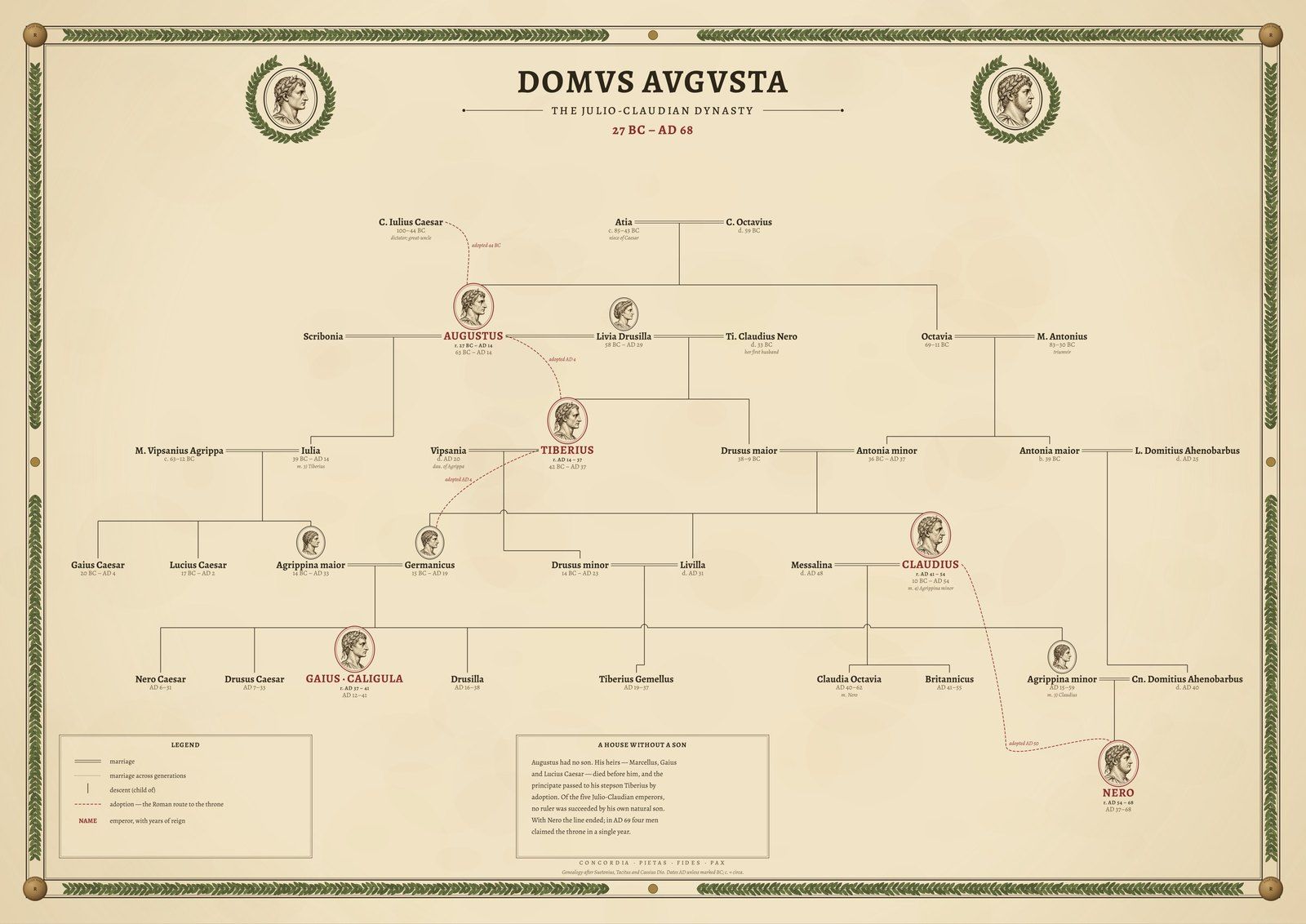
The Julio-Claudian dynasty was five emperors who ruled Rome for 94 years, from 27 BC to AD 68: Augustus, Tiberius, Caligula, Claudius and Nero. None of them was succeeded by his own son. Two heirs came to the throne by adoption (Tiberius and Nero), and two through the family of Germanicus (Caligula and Claudius).
The name joins two families. Augustus was a Julius by adoption; his wife Livia’s sons by her first husband were Claudii. Every emperor of the dynasty descends from one side, the other, or both.
The five emperors
| Emperor | Reigned | Years on the throne | Lived |
|---|---|---|---|
| Augustus | 27 BC – AD 14 | 40 | 63 BC – AD 14 |
| Tiberius | AD 14 – 37 | 23 | 42 BC – AD 37 |
| Caligula | AD 37 – 41 | 4 | AD 12 – 41 |
| Claudius | AD 41 – 54 | 13 | 10 BC – AD 54 |
| Nero | AD 54 – 68 | 14 | AD 37 – 68 |
Reign lengths are rounded to whole years, counting across the change from BC to AD without a year zero.
Augustus: Caesar’s great-nephew and adopted son
Augustus was born Gaius Octavius. His mother Atia was the daughter of Julia, the sister of Julius Caesar, which made him Caesar’s great-nephew (Suetonius, Augustus 4). At the end of his will Caesar “adopted Gaius Octavius into his family and gave him his name” (Suetonius, Julius 83). Caesar was killed in 44 BC. Octavius took the name Augustus, and his reign is dated from 27 BC.
“By Scribonia he had a daughter Julia, by Livia no children at all” (Suetonius, Augustus 63). He adopted Julia’s sons Gaius and Lucius Caesar as his heirs (Suetonius, Augustus 64), but Lucius died in AD 2 and Gaius in AD 4.
Tiberius: stepson, son-in-law, then adopted son
Tiberius was the son of Livia Drusilla and her first husband, Tiberius Claudius Nero, who gave her up to Augustus while she was pregnant with her second son (Suetonius, Tiberius 4). That made Tiberius Augustus’s stepson.
After the death of Julia’s husband Agrippa, Augustus chose his stepson Tiberius for her, “obliging him to divorce his wife, who was with child” (Suetonius, Augustus 63). So Tiberius also became Augustus’s son-in-law. When Gaius and Lucius had died, Augustus adopted him, in AD 4 (Suetonius, Augustus 65), and Tiberius was “first compelled to adopt his nephew Germanicus” (Suetonius, Tiberius 15).
That one condition shaped the next two reigns.
Caligula: grandson of Tiberius by adoption, great-grandson of Augustus by blood
Caligula, properly Gaius Caesar, was the son of Germanicus and Agrippina the Elder (Suetonius, Caligula 1).
- His father Germanicus was the son of Tiberius’s brother Drusus and the adopted son of Tiberius.
- His mother Agrippina was the daughter of Julia and Agrippa, so a granddaughter of Augustus. Augustus married her “to Germanicus his sister’s grandson” (Suetonius, Augustus 64).
So to his predecessor Tiberius, Caligula was a great-nephew by blood and a grandson by adoption. He was the first emperor descended from Augustus himself. Tiberius’s own grandson, Tiberius Gemellus, died in AD 37, the year Caligula came to the throne.
Claudius: Caligula’s uncle
Claudius was the son of Drusus the Elder, Tiberius’s brother, and Antonia the Younger (Suetonius, Claudius 1). Antonia was the daughter of Mark Antony and Augustus’s sister Octavia. He was the younger brother of Germanicus, which made him Caligula’s uncle.
He was not adopted by anyone. When Caligula was murdered in AD 41, struck down “with thirty wounds” (Suetonius, Caligula 58), Claudius hid behind a curtain in the palace. A soldier found him and hailed him as emperor (Suetonius, Claudius 10).
Nero: great-nephew, stepson, adopted son and son-in-law
Nero was born Lucius Domitius Ahenobarbus, the son of Agrippina the Younger and Gnaeus Domitius Ahenobarbus. Agrippina was a daughter of Germanicus, so Claudius’s niece. Claudius married her (Suetonius, Claudius 26), which made Nero his stepson.
Claudius then adopted Nero, in AD 50, although he had a son of his own, Britannicus, by Messalina (Suetonius, Claudius 27; Nero 7). Nero also married Claudius’s daughter Octavia (Suetonius, Nero 7). When Claudius died in AD 54, Nero “was seventeen years old” (Suetonius, Nero 8). Britannicus died the following year, AD 55.
In AD 68 Nero, facing arrest, “drove a dagger into his throat” with the help of his secretary (Suetonius, Nero 49). The dynasty ended with him.
How each emperor was related to his predecessor
| Emperor | Predecessor | Relationship |
|---|---|---|
| Augustus | (Julius Caesar, not an emperor) | Great-nephew; adopted in Caesar’s will, 44 BC |
| Tiberius | Augustus | Stepson; son-in-law; adopted son (AD 4) |
| Caligula | Tiberius | Great-nephew by blood; grandson by adoption |
| Claudius | Caligula | Uncle |
| Nero | Claudius | Great-nephew; stepson; adopted son (AD 50); son-in-law |
See it on the wall
Our Julio-Claudian family tree draws the whole house as an engraved stemma: 35 people, 13 marriages and 4 adoptions, from Julius Caesar to Nero. For the empire these men ruled, see How Many Miles of Road Did the Romans Build?
Reign and life dates and the family links are those drawn on our family tree. Quotations from Suetonius, Lives of the Caesars, in J. C. Rolfe’s Loeb translation as published on LacusCurtius. Chapter numbers follow that edition.
On the wall
Emperors & Coins